produzione| formazione | promozione | animazione
"Hortus Conclusus"
Bellezza, Amore e Primavera
Seminario a Merano
Sotto la direzione del Dr.
Jurji Alschitzdal 27 marzo al 2 aprile 2013
scene da “Il giardino dei ciliegi “
La maggior parte dei personaggi dei
drammi di A. Chekhov riguarda quello
che è costante nella nostra vita e
al contempo quello che è provvisorio.
Quali valori sono necessari per vivere?
La bellezza è uno di questi valori. Il giardino dei ciliegi è
un esempio di categoria poetica. Ma è anche un esempio di categoria filosofica.
Cos’ è tale bellezza? Noi ci chiediamo se sia visibile, udibile o persino
percepibile. Come riconoscerla? È per caso in vendita?
È possibile ottenerla in cambio di denaro? Chi compra la bellezza oggi e quanto
paga per averla?
Chekhov capì che il concetto di valore o , l’esser senza prezzo della bellezza
originale, considerato come fenomeno divino,
sarebbe gradualmente scomparso, per esser sostituito da un altro genere di
bellezza - non una bellezza autentica, ma una acquistabile.
La bellezza sarebbe divenuta puramente
merce!
Queste sono le questioni che è possibile discutere ed anche mettere in scena durante il nostro seminario.
Il nostro programma consiste: training attoriale, l'analisi del direttore delle singole scene ed esercizi pratici
L'elenco delle scene dall’ opera “ Il giardino dei ciliegi” sarà spedito in seguito.
Organizzazione: Letizia Aguanno aaletizia@gmail.com +
39 3337581726
Logistica e ospitalità: Santija Bieza santijabieza@yahoo.it
Direzione: Nazario Zambaldi
BEAUTY, LOVE and SPRING
Seminar in Merano in the spring of 2013
Under the direction of J.Alshitz
scenes from “The Cherry Orchard“
Most of characters of plays of A. Chekhov are interesting
what is constant in our life, what is temporary. What values it is necessary to
live.
The beauty is one of such values. Cherry orchard is a poetic category. But it is
philosophical category as well.
What is such - beauty? Whether it is visible, heard, notable or not? How it to
distinguish? Whether it is on sale?
Whether it is possible to get it for money? Who buys today beauty and what pays
for it?
Chekhov understood that in the coming world, the concept of value or better to
say pricelessness of original beauty
as divine phenomenon will gradually disappear, being substituted for other
beauty - not true, but selling, glamour. The beauty became the goods!
Here those questions which it is possible during our seminar not only to discuss, but also to play on a scene.
In the working day are included: actor's training, director's analysis of scenes and practical rehearsals.
The list of scenes will be sent from the play "The Cherry Orchard" in addition.
Die Schönheit, die Liebe und den Frühling
Das Seminar in Merano im Frühling 2013
Unter der Leitung Prof. Dr. J. Alschitz
Die Szenen aus dem Kirschgarten
Der handelnden Personen ist es die Stücke A.Tschechows
interessiert, dass vorübergehend und, was in unserem Leben ständig ist.
Von welchen Werten man zu leben braucht. Die Schönheit ist einer solcher Werte.
Der Kirschgarten ist eine poetische Kategorie. Aber es und die philosophische
Kategorie.
Was solches - die Schönheit ist? Ob sie sichtbar ist, ist gehört, deutlich oder
nicht? Wie sie zu erkennen? Ob sie verkauft wird? Ob man für das Geld sie
erwerben kann?
Wer kauft heute die Schönheit und was dafür zahlt? Tschechow verstand, dass es
in der tretenden Welt, den Begriff des Wertes oder besser ist,
der Kostbarkeit der echten Schönheit zu sagen wie der göttlichen Erscheinung
allmählich verlorengehen wird,
von anderer Schönheit - nicht wahrhaft, und verkäuflich, glamourös ausgewechselt
worden. Die Schönheit wurde Ware!
Jene Fragen, die man möglich ist in der Strömung unseres Seminares nicht nur, besprechen, sondern auch auf der Szene spielen.
Am Werktag sind aufgenommen: das schauspielerische Training, die Regieanalyse der Szenen und die praktischen Proben.
Die Liste der Szenen aus dem Stück «der Kirschgarten» wird
zusätzlich abgeschickt sein.
CENTRO TEATRO
Teatro PraTIKo
associazione culturale
C.R.A.T. Centro Ricerca Artistica Teatrale
+39 329 6768999 _ tel. fax: +39
0473 212014
Centro per la Cultura _ via Cavour 1 Merano _ www.centroteatro.com _
FACEBOOK: Centro Teatro Merano
info@centroteatro.com _ BLOG: centroteatromerano.blogspot.
Seminario 2011
"L'ARTE DEL DIALOGO"
"The sense of word and the art of silence"
3 - 10 maggio 2011 CENTRO TEATRO Merano
META: Teatro come mediazione
L'ARTE DEL DIALOGO per riscoprire a partire dalla scuola il dialogo e lo spazio pubblico come confronto e valorizzazione nella società senza dialogo
3 - 10 maggio CENTRO TEATRO Centro per la cultura via Cavour 1 Merano
"The sense of words and the sense of silence" seminario con il Maestro Prof. Jurij Alschitz
11 - 12 maggio
Centro culturale Trevi via Capuccini 28 Bolzano
"SCUOLA E NON SCUOLA"
CITTA' luogo della differenza e del dialogo con:
Stoa (Societas Raffaello Sanzio, Cesena)
NON SCUOLA (Teatro delle Albe, Ravenna)
META: Teatro e Arte come mediazione
Corso di aggiornamento n. 31 Piano Intendenza scolastica Provincia di Bolzano 2010/11
INFO: info@metaart.it - + 39 329 6768999
Seminario 2009:
TEATRO PEDAGOGICO
L'arte di insegnare teatro
Luogo: Merano, Centro della Cultura, via Cavour 1
Periodo: marzo 2009
http://www.alschitz.blogspot.com/
http://lego4.blogspot.com/2009/01/art-of-teaching-actors-in-italy-merano.html
THE ART OF TEACHING
THEATRE
““There exists an expression: "when you will give something to somebody, you
will get it" or - "if you like to have something -
give it to someone".
The same
rule can be applied to theatre - you will get all knowledge about acting, in the
moment when you give all your knowledge to your student.
I call this seminar theatre training from "A" to "Z". I know this proposition
sounds impossible to do in such a short time, but I want to give you as much as
possible from my knowledge, which I gained and
accumulated during 20 years of teaching experience.
In the beginning of my career I did not plan to work as an acting teacher.
I started from acting, later I studied directing, and
then I moved my attention more and more to teaching. I like how my way turned
out. I like teaching theatre very much. In this moment I am working
on my new book for theatre teachers. I believe, that
only better theatre schools can make theatre itself better. But we will only
have good schools, if we have good teachers.
For these 9 days of work I plan to touch a lot of questions by speaking about
the most crucial themes in education, and we will do a lot of practical
exercises. We will discuss and ask: How to select the right students for a
theatre school? How to open the talent of your student? How to organize the plan
of the lessons, of the semester, and how to develop a whole study-plan for a
group or the individual students? How to organize an ensemble, and finally how
to take care about ourselves - the theatre teachers?
We should have a special training for teachers as well!
Probably you are working today as an actor or actress, or as director but
knowledge about teaching will always help you in your future.
Who knows what will happen... “
Prof. Dr. Jurij Alschitz
Jurij Alschitz’
work as an actor, director, and professor is deeply rooted in the rich soil of
Russian theatre tradition, stemming from the ongoing process of research and
development in acting methods started by Stanislavsky.
After studying with Anatoly
Vasiliev at the Russian Academy for Theatre Arts, Dr. Alschitz joined him in
1987 at the theatre “School of Dramatic Art”, where he continued to develop his
rehearsal and training methods. In 1994—1995 he founded a series of independent
international theatre centers in Berlin, Rome, Stockholm, and Oslo. These
centers joined forces in 2000 to form the European Association for Theatre
Culture (EATC), with the goal of bringing together the world’s different theatre
traditions.
Publications: Die Vertikale
der Rolle, 40 Fragen an eine Rolle, La Grammatica dell‘attore, La Matematica
dell’attore, Teatro senza regista, The Vertical of the Role, 40 Questions of one
Role, Training Forever.
The seminar THE ART OF TEACHING THEATRE by Jurij Alschitz
is dedicated to actors, directors and teachers.
The Seminar begins on Friday the 6th of March and ends on Saturday the 14th of March.
The lessons will take place each day indicatively from 14.30 till 19.30
in Centro per la Cultura, Via Cavour 1, Merano
(http://www.mairania857.org/index.php?id=39&L=0).
The Seminar is open to all persons interested in theatre and/or teaching.
There is no selection, but please send us your CV or a brief biography note. The number of participants is limited.
The cost of the seminar is 315,00 €, and a student can apply by paying the application quote on the following bank account:
Banca Popolare dell’Alto Adige, Merano, P.zza del Grano
IBAN: IT76B0585658 590040571081572
Causal: Seminario Alschitz 2009
The application quote includes the membership card of Teatro PraTIKo of 15,00 €.
Merano is distant around 30 minutes from Bolzano by train.
Bolzano is distant around 4 hours and 30 minutes from Munchen by train, and around 3 hours and 30 minutes from Milan by train.
For further information you can visit:
http://www.ferroviedellostato.it/
In the centre of the town there is a very nice youth hostel with no age limit, where one night stay included breakfast and bedding costs 19,50€.
For further information you can visit:
http://meran.jugendherberge.it/cs.asp?st=1&sp=en
Info: Nazario Zambaldi+ 39 335 8388554
C.R.A.T. Centro Ricerca Artistica Teatrale
Teatro PraTIKo Associazione Culturale
The detailed programme of the Seminar follows soon!
Il Seminario L'ARTE DI INSEGNARE TEATRO condotto dal maestro Jurij Alschitz
è dedicato ad attori, registi e insegnanti.
Il Seminario inizia venerdì 6 marzo e finisce sabato il 14 marzo.
Le lezioni avranno luogo tutti i giorni indicativamente dalle 14.30 alle 19.30
al Centro per la Cultura, via Cavour 1, Merano
(http://www.mairania857.org/index.php?id=39&L=0).
Il Seminario è aperto a tutte le persone interessate al teatro e/o all'insegnamento.
Non è prevista selezione, ma siete comunque pregati di mandarci il vostro CV o una breve nota biografica. Il numero di partecipanti è limitato.
Il costo del Seminario è 315,00 € ed è possibile iscriversi effettuando il pagamento della quota d'iscrizione sul seguente conto bancario:
Banca Popolare dell’Alto Adige, Merano, P.zza del Grano
IBAN: IT76B0585658 590040571081572
Causale: Seminario Alschitz 2009
La quota d'iscrizione include la tessera socio del Teatro PraTIKo di 15,00 €.
Merano dista circa 30 minuti in treno da Bolzano (30 km).
Bolzano dista circa 4ore e 30 minuti da Monaco di Baviera, e circa 3 ore e 30 minuti da Milano e Bologna.
Per ulteriori informazioni:
http://www.ferroviedellostato.it/
Nel centro di Merano si trova un ostello della gioventù molto carino e senza limiti di età,
dove un pernottamento, colazione e biancheria da letto inclusi, costa 19,00€.
Per ulteriori informazioni:
http://meran.jugendherberge.it/cs.asp?st=1&sp=en
Info: Nazario Zambaldi
+ 39 335 8388554
C.R.A.T. Centro Ricerca Artistica Teatrale
Teatro PraTIKo Associazione Culturale
Il programma dettagliato del corso seguirà a breve!
Seminario 2007:
LA METAFISICA DELL’ATTORE
Seminario 2006:
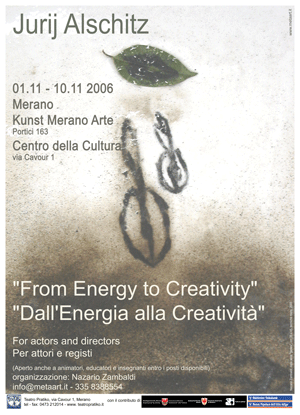
DALL'ENERGIA ALLA CREATIVITA'
“Mi sembra che il teatro moderno in tutte le sue forme, gradualmente arriva ad un totale annullamento delle basi metafisiche della vita nel lavoro attoriale. La vita dell’attore in scena è limitata e sensualmente “ordinata”. L’attore moderno si permette di tutto per il puro sperimentare. Anche se gli attori non negano il pensiero metafisico al livello verbale, lo ignorano completamente nel lavoro effettivo. Quello che succede è che l’attore non conosce le ricchezze delle proprie opportunità (capacità), non sa come recitare “l’invisibile” e “l’ignoto” e di conseguenza ne rifugge.”
J. Alschitz
METAFISICA DELL’ATTORE
10 giorni di seminario-ricerca (seminario laboratoriale) per attori e registi
Merano, 21.06.2007. – 30.06.2007.
Programma di lavoro
- Metafisica del teatro – lezioni teoriche
- Il training del teatro metafisico
- La formazione del modello individuale del linguaggio metafisico dell’attore
- L’analisi del testo e il lavoro scenico con i testi di Platone, Shakespeare e Chekhov
Nel training di gruppo l’attore avrà la possibilità di studiare, conoscere e sviluppare, le tecniche attoriali e le proprie abilità naturali.
Nel lavoro sul testo, ogni partecipante avrà la possibilità di indagare i nuovi spazi della recitazione e di scoprire il proprio linguaggio metafisico.